SKIN DEVELOPMENT : TYPES AND CAUSES OF FACIAL WRINKLES
What types of skin wrinkles are there and what causes them? Here you can learn more about typical facial wrinkles and the important structural protein in the skin.
As can be seen in the illustration, forehead wrinkles run across the eyebrows. Below the eyes, so-called crow’s feet appear, which become visible when smiling or squinting. Nasolabial folds appear at the sides of the mouth and, in addition, chin wrinkles appear on the chin. These lines are caused by facial expressions and natural changes in the skin as we age. These are just some of the facial wrinkles that become more pronounced as the skin develops and ages.
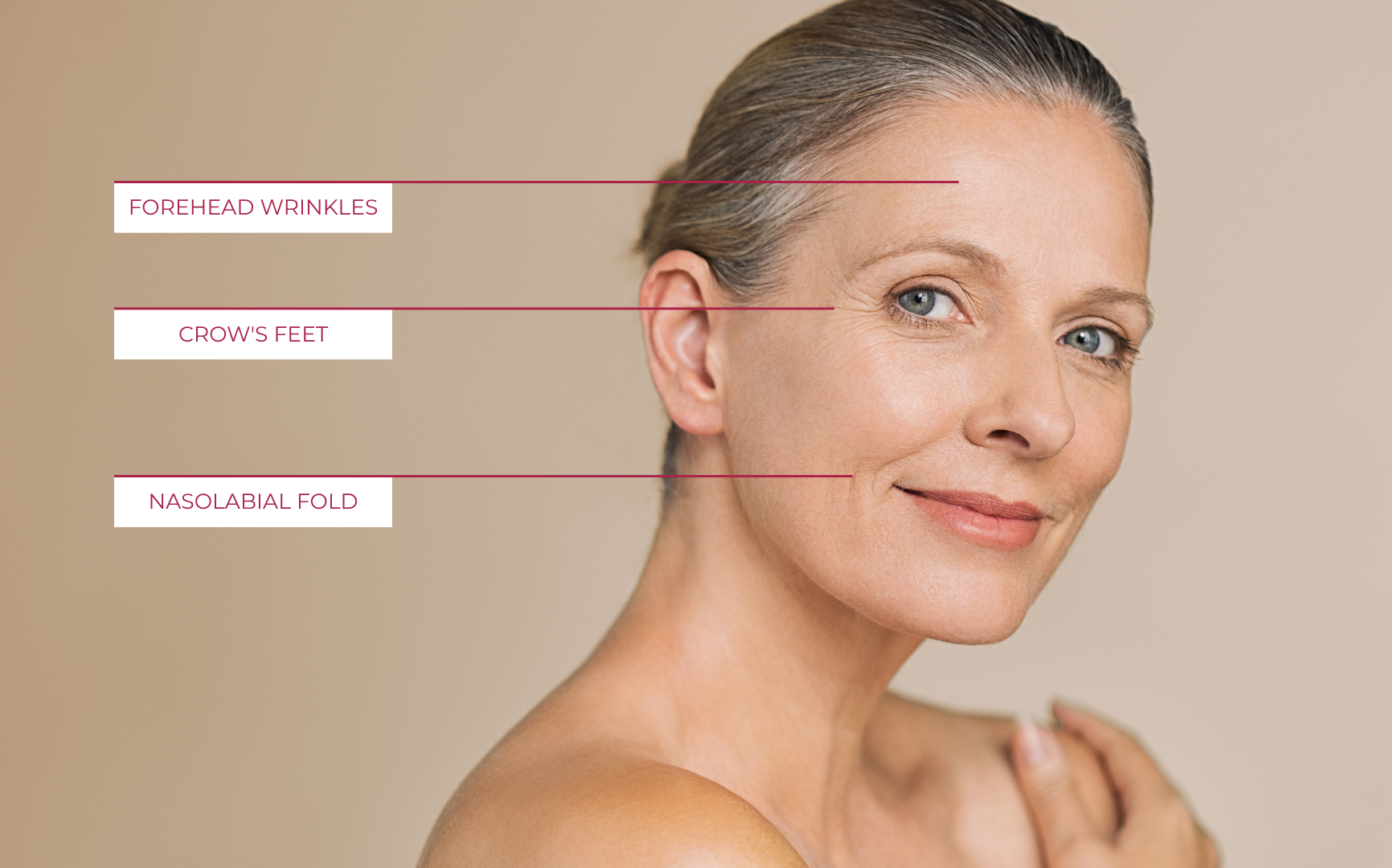
Skin development: What types of facial wrinkles are there?
Our skin changes over the years – and with it its structure, tone and elasticity. A natural part of this skin development is the formation of facial wrinkles. Whether forehead wrinkles, crow’s feet or nasolabial folds – each type of wrinkle has its own causes and characteristics. In this overview, we show which wrinkles typically appear on the face, how they are related to the ageing process and what they reveal about skin development. The decline in fibroblast activity plays a central role in this process: these cells produce collagen, among other things, which is responsible for the firmness of the skin. As their performance declines, less collagen and hyaluronic acid are produced, causing the skin to lose stability and firmness.
FOREHEAD WRINKLES
Also known as: worry lines
Forehead wrinkles are dynamic wrinkles that are caused by repeated muscle movements, such as when worrying or feeling angry. Treatment with botulinum toxin (Botox) can smooth these wrinkles, but carries the risk of a stiff facial expression or loss of facial expression. Dry skin also increases the visible effect of forehead wrinkles.
CROW´S FEET
Also known as: periorbital wrinkles
Crow’s feet are fine wrinkles around the eyes which, similar to forehead wrinkles, are often caused by repeated movements of the facial muscles such as laughing, blinking or straining the eyes. Their radiating shape is reminiscent of bird feet. Over time, they become permanently deeper – especially in dry skin that lacks elasticity.
NASOLABIAL FOLD
Also known as: nasolabial folds
Nasolabial folds run between the nostrils and the corners of the mouth. They can make the face appear older and more tired. Their formation is usually due to natural ageing processes and genetic predisposition. As with many wrinkles, the same applies here: when the skin is dry, the wrinkle becomes more visible and appears deeper.
CHIN WRINKLES
Also known as: strawberry chin
Chin wrinkles run across the chin, creating an uneven appearance. These wrinkles are caused by the contraction of facial muscles during facial expressions. The muscles repeatedly contract during certain facial expressions, forming wrinkles.
ANGER WRINKLES
Also known as: concentration lines, glabellar lines, thinker’s lines and frown lines
Frown lines are expression lines that form as a result of repeated tension in the facial muscles above the bridge of the nose. These lines can run vertically, diagonally or horizontally. They give the impression of negative emotions and make the face appear older. The frown line is not a sign of illness. It is usually treated for cosmetic reasons.
BUNNY FOLDING
Also known as: witch’s wrinkles
Bunny lines are located on the sides of the bridge of the nose. They are caused by wrinkling the nose or laughing and are among the expression lines that are caused by repeated muscle contractions. With increasing age and decreasing skin elasticity, these wrinkles can become permanent.
UPPER LIP WRINKLES
Also known as: pleated wrinkles or perioral wrinkles
Upper lip wrinkles are usually vertical lines on the upper lip. They are caused by the natural ageing process and by many years of smoking. Dry skin is often the reason why these wrinkles become visible.
NECK WRINKLES
Examples of neck wrinkles: turkey neck, platysma bands and transverse neck wrinkles
Wrinkles in the neck area are caused by the natural ageing process. The skin becomes thinner and the fatty tissue under the skin decreases. Muscle movements also contribute to this. Vertical wrinkles are called turkey neck. Vertical wrinkles often occur on the sides together with transverse wrinkles.
Skin development: What is the best way to prevent wrinkles?
Wrinkles are a natural part of ageing – but there are many ways to prevent them from forming and keep your skin smooth, supple and well hydrated for longer. The key is a holistic lifestyle that takes both external and internal factors into account.
Effective measures for preventing wrinkles:
- Daily UV protection: Sunlight is one of the main causes of premature skin ageing. A day cream with sun protection factor protects against UV-induced collagen breakdown.
- Sufficient sleep: Regeneration and cell renewal take place mainly at night. Too little sleep causes the skin to age faster.
- Avoid nicotine: Smoking impairs blood circulation and destroys important building blocks of the skin, including collagen and elastin.
- Nutrient-rich diet: A balanced diet with vitamins, minerals, antioxidants and healthy fats supports the skin from within.
Supplement skin-relevant nutrients: Regular intake of bioactive collagen peptides in combination with vitamin C can promote collagen formation and thus strengthen the skin structure in the long term.